
I bid farewell to a WWII submarine veteran in 2014.
Ninety-year-old Chester Bienkowski led a long and successful life, starting when America went to war in December 1941.
He enlisted in the Navy a month later and served on diesel submarines out in Hawai’i.
Some of you will remember that 20% of American submarines left Pacific ports and never returned.
I got to know Chet years ago when he visited his family, my neighbors, on Oahu. We’d chat on the banks of Pearl Harbor about his experiences — hair-raising and detailed.
I loved talking with a man with firsthand knowledge of the war, having served not far from where we lived.
After the war, Chet stayed in the Navy and continued to ride and fix submarines. Once he retired, he went to work at Mare Island Naval Shipyard, still fixing subs. In his free time, he overhauled the USS Pampanito (SS-383), which tourists can visit in San Francisco.
Chet’s proudest moment was when they got the boat’s diesel engines to run again after years of inactivation.
(Movie makers used the Pampanito in the film Down Periscope. I do not recommend if you are looking for accuracy about submarine life.)
St. Peter’s Chapel
The services took place at St. Peter’s Chapel on Mare Island. We used to attend that jewel of a chapel filled with Tiffany stained-glass windows.

We had not visited the chapel in a long time.
Like many military chapels, it’s designed to accommodate both the Catholic mass and Protestant worship services.
The windows’ Bible stories gleamed bright on that sunny Saturday.
I’d forgotten the chapel’s beauty and took photos.
We weren’t the only people arriving early. Chet was active in the local Submarine Veterans’ Association. Many of his friends attended in their distinctive blue vests bearing patches and pins of the various boats.
I hadn’t seen the vest since Hawai’i, and it gave me pause. These “dolphin wearers” never forget the submariners who did not return from the sea.

The chapel’s A-frame ceiling also remembers them. I’ve written other posts about the loss of both the USS Thresher and the USS Scorpion. The Submarine Veterans’ Association sponsors plaques remembering those nuclear submarines still “plowing the seas.”
I had to blink back tears while taking the photos.
Still on patrol
Tears flowed during the service, when several veterans rang a ship’s bell and named each WWII submarine “still on patrol.”
As the list went on and on, the enormity of the loss hit me all over again. Fifty-two submarines never returned from operations in the Pacific.
(The naval chapel at Pearl Harbor remembers one submarine each Sunday.)
Because my husband wears dolphins, too, submarine losses are tough for me to think about.
The older sub vets told stories about Chet, remembering his good humor, dedication to the job, and hard work. We enjoyed hearing the stories.
It sobered us to realize how few WWII veterans remain.
16 million men and women fought in World War II. Less than a million of them are still alive; 555 die every day.
The US Census Department expects the last one to die by 2036. (The last American veteran of WWI died in 2012 at the age of 110.)
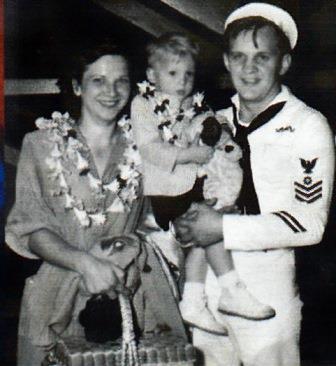
If we want to hear their stories, we need to hurry.
I like to remember how much Chet enjoyed his military life. He traveled to Hawai’i to visit his grandchildren and always flew Space-A (Space Available) out of Travis Air Force Base.
He celebrated the 50th anniversary of World War II by flying on a refueling tanker plane. It was escorting the Blue Angels across the Pacific Ocean.
He even got to look out the porthole to watch the pipe refuel the Blue Angels in flight.
He loved telling the story, and I loved hearing about it from him.
On Veteran’s Day, make sure you stop and listen to the veterans around you. You don’t have to overwhelm them with gratitude. Most of the veterans I know consider their service just part of their lives.
But listen to their stories before they’re gone.
I’m glad I heard Chet’s.
Tweetables
Saying good-bye to a veteran at a beautiful Navy chapel. Click to Tweet
This Veteran’s Day listen to their stories before they’re gone. Click to Tweet
52 submarines never returned from WWII patrols. Click to Tweet


So glad you could hear his story, Michelle. My uncles, all of whom were in WWII, were always reluctant to talk about it–for good reasons, I’m sure. Thanks for the sacrifices your husband and you and your family have made for all of us!
We’ve seen the same thing with other relatives. One out-law played in an Army band in the South Pacific throughout the war. He never said a word about his auxiliary duties–which was picking up and burying the dead following a battle. Too horrible to contemplate, but he did return to Fiji after the war and served in ministry there. He preferred to focus on the living, not the dead.